
Los Angeles County operates one of the largest jail systems in the United States, managed by the Los Angeles County Sheriff’s Department. When someone is arrested in LA County, they are typically booked into one of several county jails, such as Men’s Central Jail, Twin Towers Correctional Facility, or the North County Correctional Facility. An inmate remains in county custody until their case is resolved, they are released on bail, or they are transferred to state prison. Because of the size and complexity of the system, locating an individual requires using official tools designed to provide real-time, accurate data. The primary method for conducting a Los Angeles County inmate search is through the Sheriff’s Department’s online inmate information center, which is updated regularly and accessible to the public 24/7.
Unlike state prison inmates, who are tracked by the California Department of Corrections and Rehabilitation (CDCR), county jail inmates are not included in the state’s inmate locator system. This means anyone searching for a person recently arrested must use the LA County Sheriff’s tool. The system allows searches by name or booking number and returns key details such as current location, charges, bail amount, and scheduled court dates. It is critical to use the correct agency—using the CDCR tool will not return results for someone still in county jail. The LA County inmate database is a public record, but access is limited to protect privacy and ensure security. Only verified, non-sensitive information is displayed, and certain data may be withheld if it involves ongoing investigations or protected individuals.
Official Los Angeles County Inmate Search Tool
The Los Angeles County Sheriff’s Department provides a free, online inmate locator tool that allows anyone to search for individuals currently in custody. This system is the most reliable and up-to-date source for jail records in LA County. It is maintained by the Sheriff’s Information Bureau and updated multiple times per day to reflect new bookings, releases, and transfers. The tool is designed for public use and does not require registration or personal information to access. All data is pulled directly from the Sheriff’s jail management system, ensuring accuracy and timeliness. This service is available at all times and can be used from any device with internet access.
How to Use the Online Inmate Locator
To begin a search, go to the official LA County Sheriff’s inmate information portal at https://app5.lasd.org/iic/. The homepage displays a simple form with two main search options. You can search by the inmate’s name or by their booking number. If you choose to search by name, enter the last name in the first field and the first name in the second. Middle names or initials are optional, but can help narrow results if multiple people share the same name. If you have the booking number, enter it in the designated field. This number is typically provided by law enforcement at the time of arrest or can be obtained by calling the jail facility.
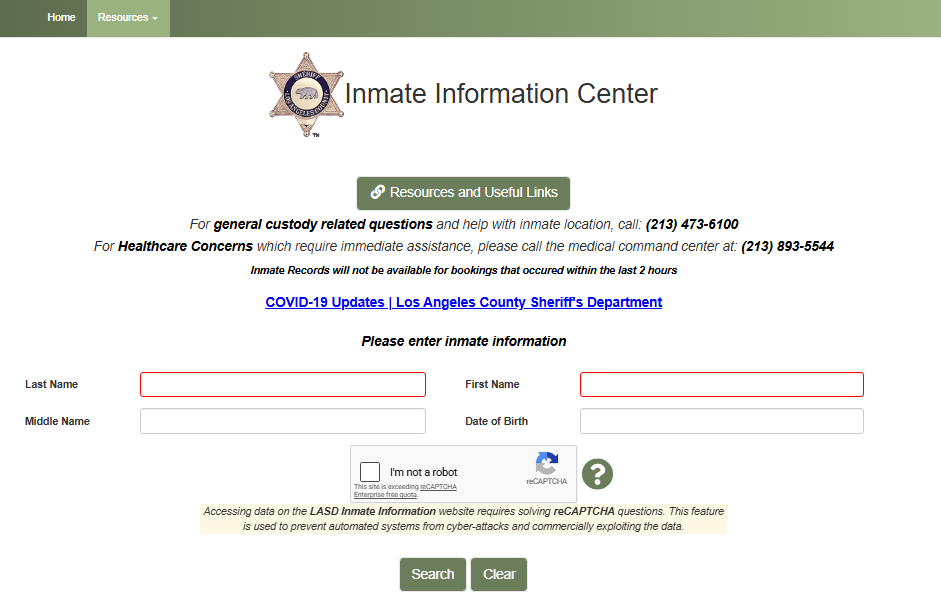
After entering the required information, click the “Search” button. The system will process the request and display matching results. Each result includes the inmate’s full name, age, sex, race, booking number, arrest date, arresting agency, current housing location, charges, bail amount, and next court date. If no matches are found, the system will indicate that no records are available. It is important to double-check spelling and try variations of the name if the initial search fails. The tool does not support partial name searches, so full names must be entered correctly.
Required Search Fields and Input Format
The inmate locator requires specific information to return accurate results. For a name-based search, you must enter the last name and first name in the correct fields. The system is case-insensitive but sensitive to spelling. Do not include titles, suffixes, or nicknames unless they were used during booking. For example, “John Smith Jr.” should be entered as “Smith” in the last name field and “John” in the first name field. Middle initials can be added in the optional third field. If searching by booking number, enter the full alphanumeric code exactly as provided. Booking numbers in LA County typically begin with a letter followed by numbers, such as “A12345678.”
- Last Name: Enter the inmate’s legal last name (required).
- First Name: Enter the inmate’s legal first name (required).
- Middle Name/Initial: Optional, but helpful for disambiguation.
- Booking Number: Full code including letters and numbers (if known).
What Information Is Displayed in Search Results
Each search result provides a detailed summary of the inmate’s current status. The system displays the following data points for every match:
| Data Field | Description |
| Full Name | Legal name as recorded during booking. |
| Age | Current age based on date of birth. |
| Sex | Male, female, or other as self-identified. |
| Race | Self-reported racial category. |
| Booking Number | Unique identifier assigned at intake. |
| Arrest Date | Date and time of arrest. |
| Arresting Agency | Police department or agency that made the arrest. |
| Housing Location | Current jail facility and module/unit. |
| Charges | List of criminal charges with penal code references. |
| Bail Amount | Set bail amount or “No Bail” if denied. |
| Next Court Date | Scheduled appearance in criminal court. |
This information is updated in real time and reflects the most current status of the inmate. However, certain details such as medical conditions, disciplinary records, or internal investigations are not publicly available due to privacy and security regulations.
Searching by Name vs. Booking Number
There are two primary methods to locate an inmate in Los Angeles County: by name or by booking number. Each method has advantages and limitations. Searching by name is the most common approach, especially when the booking number is unknown. However, it can return multiple results if several individuals share the same name. Searching by booking number is more precise and returns a single result if the number is correct. Booking numbers are assigned at the time of intake and remain with the inmate throughout their stay in county custody. They are often provided to family members or attorneys during initial contact with law enforcement.
When to Use a Name-Based Search
A name-based search is appropriate when you do not have the booking number or when the person was recently arrested and the number has not yet been shared. This method is useful for family members, friends, or legal representatives trying to confirm custody status. However, because LA County processes thousands of arrests annually, common names like “Michael Garcia” or “Maria Lopez” may return dozens of matches. To improve accuracy, include the middle initial if known. The system does not support wildcard searches or partial name matching, so spelling must be exact. If the initial search yields no results, try alternate spellings or check for possible name changes.
It is also possible that the person has not yet been booked or is still in transit between facilities. In such cases, the system may not show their information until processing is complete. Booking can take several hours, especially during busy periods. If no record appears after 24 hours, contact the arresting agency or the jail directly for confirmation.
When to Use a Booking Number Search
A booking number search is the fastest and most accurate way to locate an inmate. This number is a unique identifier assigned during the intake process and remains constant throughout the individual’s stay in the county jail. It is typically provided by police officers at the time of arrest or can be obtained by calling the Sheriff’s Department. Once you have the number, enter it into the designated field on the inmate locator page. The system will return a single result with full details, eliminating the need to sift through multiple names.
This method is especially useful for legal professionals, bail bond agents, or family members who need immediate access to specific information. It is also helpful when the inmate has a common name or when time is critical, such as arranging for bail or visitation. Booking numbers are also used in court documents, so they may appear on arrest reports or citations.
Common Issues and How to Resolve Them
Several issues can prevent a successful search. The most common is incorrect spelling or outdated name information. If the inmate used a nickname or alias during booking, the system may not recognize their legal name. In such cases, try searching with the name they were known by at the time of arrest. Another issue is delayed data entry. Although the system is updated frequently, there can be a lag between booking and online availability. If no results appear, wait a few hours and try again.
- No results found: Verify spelling, try alternate names, or wait for system update.
- Multiple matches: Use middle initial or narrow by age and location.
- Outdated information: Contact the jail directly for confirmation.
- Technical errors: Refresh the page or try a different browser.
Understanding Inmate Status and Release Dates
Once an inmate is located, the system provides key details about their legal status. This includes whether they are being held without bail, have a bail amount set, or are awaiting trial. The “Next Court Date” field shows when the individual is scheduled to appear in court, which is critical for legal planning and family coordination. Release dates are not always displayed because they depend on court decisions, bail payments, or sentencing outcomes. Inmates may be released at any time based on judicial rulings, so the system does not predict future release dates.
Types of Inmate Status
Inmates in LA County jails can have several different statuses, each affecting their custody timeline. “In Custody” means the person is currently held in a county facility. “Released” indicates they have been discharged, either through bail, court order, or completion of sentence. “Transferred” means the inmate has been moved to another facility, such as a state prison or a medical center. “Pending Court” means the individual is awaiting a hearing or trial. These statuses are updated as changes occur, but there may be a short delay in online reflection.
It is important to note that “Released” does not always mean the case is closed. An inmate may be released on bail but still face charges. Similarly, a transfer to state prison means the individual has been sentenced and is no longer in county custody. The inmate locator will no longer show their information once they are transferred out of the county system.
How Bail Affects Release
Bail is a financial guarantee that an inmate will return for court appearances. If bail is set, the amount is displayed in the search results. Payment can be made in cash, through a bail bond agent, or via property bond. Once bail is posted, the inmate is typically released within a few hours, depending on processing time. If bail is denied, the inmate remains in custody until the case is resolved. Bail amounts vary based on the severity of charges, criminal history, and flight risk. Judges review bail during arraignment, which usually occurs within 48 hours of arrest. Bail can be modified during court proceedings. If new evidence emerges or circumstances change, a judge may reduce, increase, or revoke bail. These changes are reflected in the inmate locator once updated in the system. Family members or attorneys can request bail hearings through the court.
Release Date Estimates and Limitations
The inmate locator does not provide estimated release dates because they are highly variable. Release depends on multiple factors, including court schedules, plea agreements, sentencing, and parole eligibility. For misdemeanor charges, inmates may serve time in county jail and be released after a few days or weeks. For felonies, they may be transferred to state prison after conviction. The system only shows the next court date, not the outcome. To track progress, monitor the inmate’s status regularly, and consult court records for updates.
Inmates sentenced to less than one year typically serve their time in county jail. Those sentenced to longer terms are transferred to CDCR custody. Once transferred, they are no longer searchable through the LA County tool and must be located using the state’s inmate locator at http://cdcr.ca.gov/.
Visitation and Contacting an Inmate
Visitation policies in LA County jails are strict and vary by facility. Each jail has specific days, times, and rules for visits. Inmates must be on the approved visitor list, and all visitors must present a valid photo ID. Minors under 18 must be accompanied by a parent or legal guardian. Some facilities allow non-contact visits through glass partitions, while others permit contact visits in designated areas. All visits are subject to monitoring and may be denied for security reasons.
How to Schedule a Visit
To visit an inmate, you must first confirm their housing location using the inmate locator. Then, contact the specific jail to request visitation. Most facilities require advance registration. For example, Men’s Central Jail allows visits by appointment only, scheduled through the Sheriff’s website or by phone. Visitors must provide their full name, relationship to the inmate, and contact information. Approval can take up to 72 hours. Walk-in visits are not permitted.
Visitation hours vary. For instance, Twin Towers Correctional Facility offers visits on weekends from 8:00 AM to 3:00 PM. Each inmate is allowed one 30-minute visit per week. Visitors must arrive 30 minutes early for processing. Late arrivals may be denied entry. All personal items, including phones and bags, must be stored in lockers.
Rules and Restrictions
All visitors must follow strict conduct rules. Inappropriate behavior, such as shouting or attempting to pass contraband, can result in permanent bans. Dress codes are enforced—revealing clothing, gang symbols, or inappropriate messages are prohibited. Food, gifts, or money cannot be brought into the facility. Inmates receive funds through the jail’s commissary system, which can be loaded online or by phone.
- Valid ID required: Driver’s license, passport, or state ID.
- No electronic devices: Phones, cameras, or recording equipment.
- No outside food or drinks.
- No physical contact with other visitors.
Sending Mail to an Inmate
Inmates can receive mail, but all correspondence is inspected for security. Letters must include the inmate’s full name, booking number, and housing location. Use the following format:
- John Doe #A12345678
- Men’s Central Jail
- 441 Bauchet St
- Los Angeles, CA 90012
Do not send cash, stamps, or Polaroid photos. All mail must be on standard paper and in a plain envelope. Books and magazines must be sent directly from the publisher. Packages are not accepted. Mail delivery can take 3–5 business days.
Legal and Privacy Considerations
The Los Angeles County inmate locator is a public record tool, but it is subject to state and federal privacy laws. Not all information is disclosed. For example, inmates under protective custody, juveniles, or those involved in sensitive investigations may have their records restricted. The Sheriff’s Department may withhold details if disclosure could compromise safety or ongoing operations. Additionally, certain personal data, such as medical or mental health records, is protected under HIPAA and not available to the public.
Public Access vs. Privacy Rights
California law allows public access to jail rosters and booking information under the California Public Records Act. However, this access is balanced against individual privacy rights. The LA County Sheriff’s Department follows strict guidelines to ensure only non-sensitive data is released. For example, while names, charges, and bail amounts are public, details about medical treatment, disciplinary actions, or internal investigations are not disclosed. This protects both the inmate and the integrity of law enforcement operations.
Family members or legal representatives may request additional information not shown online. Such requests must be made in writing and may require proof of relationship or legal authority. The Sheriff’s Department reviews each request and responds within 10 business days. Denials can be appealed through the County Counsel’s office.
Accuracy and Data Integrity
The inmate locator is updated multiple times per day using data from the Sheriff’s jail management system. However, errors can occur due to manual entry, system glitches, or delays in processing. If you believe information is incorrect—such as a wrong charge or outdated location—contact the Sheriff’s Information Bureau at (213) 473-6100. Provide the inmate’s name, booking number, and a description of the error. Corrections are typically made within 24–48 hours.
It is also possible for inmates to be misidentified or for names to be misspelled during booking. In such cases, legal counsel should file a motion with the court to correct the record. The Sheriff’s Department cannot alter booking information without a court order.
Use of Inmate Data
Information from the inmate locator should be used responsibly. It is intended for legitimate purposes such as locating a family member, arranging legal representation, or posting bail. Misuse of the data—such as harassment, stalking, or publishing private details—can result in legal consequences. The Sheriff’s Department monitors usage patterns and may block IP addresses engaged in abusive behavior. Always respect the privacy and dignity of individuals in custody.
| Official Contact | Los Angeles County Sheriff’s Department Sheriff’s Information Bureau 441 Bauchet St, Los Angeles, CA 90012 |
| Phone | (213) 473-6100 |
| Hours | Monday–Friday: 8:00 AM – 5:00 PM Saturday–Sunday: Closed *Online tool available 24/7 |
(FAQs) About the Los Angeles County Inmate Search
The following FAQs provide quick and practical answers to common questions about the Los Angeles County Inmate Search system. They are designed to help users understand how the database works, possible delays, search limitations, and what type of information is available or restricted within public records.
How long does it take for an inmate to appear in the search system after arrest?
In most cases, an inmate’s information appears within 2 to 6 hours of booking. However, during high-volume periods or if the individual is processed at a remote facility, delays of up to 24 hours can occur. The system is updated in real time, but data entry depends on staff availability and facility workload. If no record appears after 24 hours, contact the arresting agency or the jail directly. Provide the person’s full name, date of birth, and approximate arrest time to assist in the search. Keep in mind that some individuals may be held in temporary holding cells before formal booking, which can delay online visibility.
Can I search for an inmate using only their first name or nickname?
No, the Los Angeles County inmate locator requires both a first and last name to search. Partial names, nicknames, or aliases are not supported unless they were used during the official booking process. If the person was booked under a nickname, try searching with that name instead of their legal name. The system does not allow wildcard characters or fuzzy matching, so spelling must be exact. If you are unsure of the name used, contact the arresting agency or the jail’s information desk for clarification. Providing additional details like date of birth or arrest location can help staff locate the correct record.
Why does the search show “No Records Found” even though I know the person is in jail?
Several factors can cause this result. The inmate may not have been processed yet, especially if arrested within the last few hours. Data entry delays, system outages, or incorrect spelling can also prevent matches. Additionally, if the person was arrested outside Los Angeles County or is in state prison, they will not appear in this database. Try searching again after a few hours, double-check the name spelling, or contact the Sheriff’s Department at (213) 473-6100. If the arrest occurred in another county, use that jurisdiction’s inmate locator tool instead.
Is inmate information available for people released more than 30 days ago?
No, the Los Angeles County inmate locator only displays information for individuals currently in custody. Once an inmate is released, transferred, or discharged, their record is removed from the public search tool. Historical booking data is not retained online and is not accessible through this system. To obtain records for past inmates, submit a formal request to the Sheriff’s Records Bureau. This may require a completed form, proof of identity, and a processing fee. Response times vary, and some records may be restricted due to privacy laws or ongoing investigations.
Can I get an inmate’s medical or mental health information through the search tool?
No, medical and mental health records are strictly confidential and protected under federal and state privacy laws, including HIPAA. The inmate locator only displays non-sensitive information such as name, charges, bail, and court dates. Medical conditions, treatment plans, or psychological evaluations are not disclosed to the public. Only authorized medical staff, legal representatives with proper documentation, or court-ordered personnel can access such records. If you are a family member concerned about an inmate’s health, contact the jail’s medical services unit through the Sheriff’s Department. They may provide general updates if permitted by the inmate’s consent.